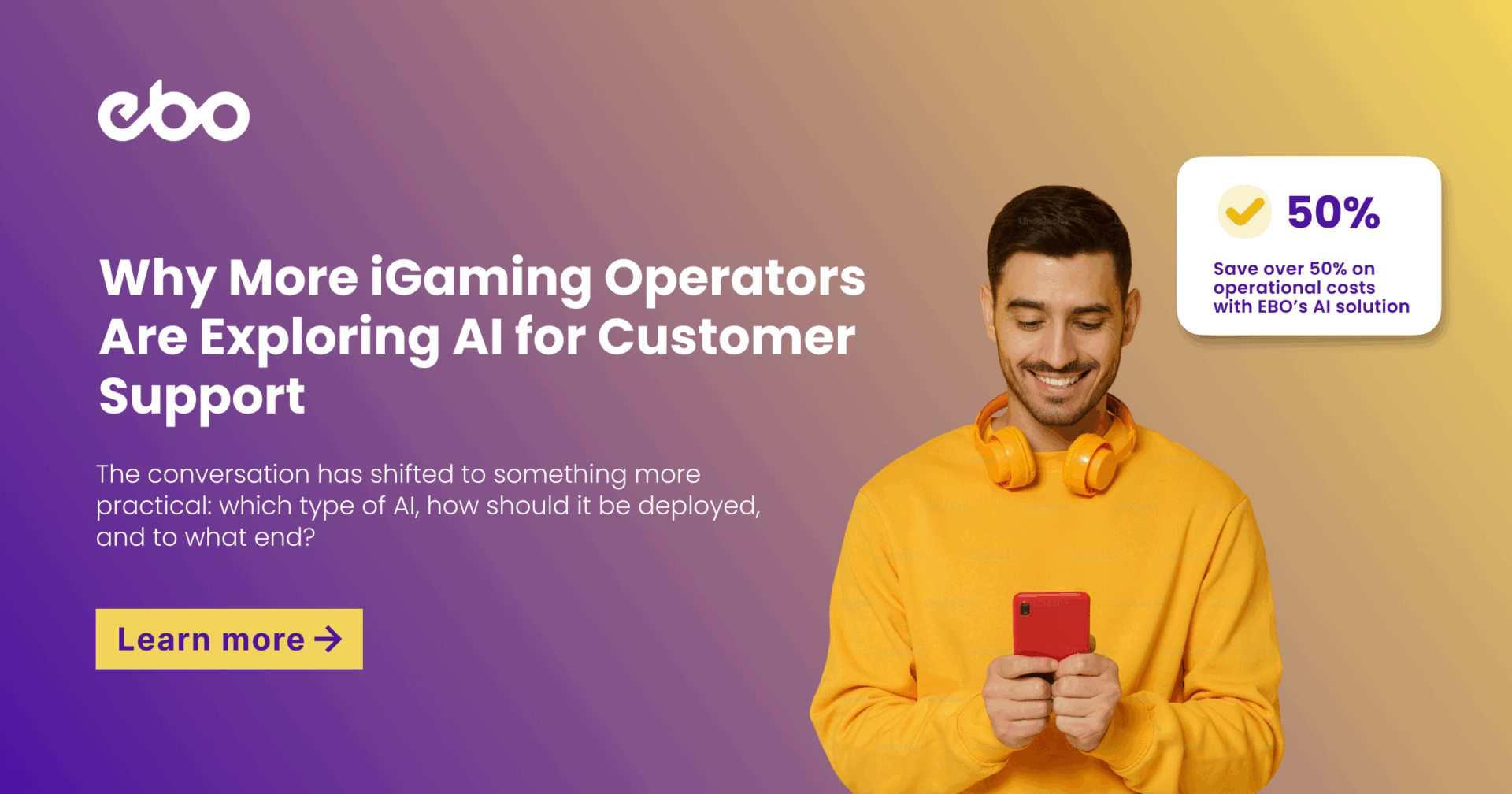
In iGaming, the question is no longer whether AI belongs in customer service. The real focus now is how operators deploy it effectively and what outcomes it delivers.
For leadership teams, AI has moved beyond experimentation. It is now a core operational capability driving efficiency, compliance, and player experience at scale.
From Virtual Agents to Agentic AI
Earlier AI tools were limited to scripted or linear conversations. They could respond, but not act.
Agentic AI changes that model entirely.
By connecting directly with core systems such as CRM platforms, payment providers, KYC/AML tools, and compliance workflows, Agentic AI can take meaningful action within a single conversation.
This means tasks such as verifying documents, updating account information, processing bonuses, or escalating responsible gaming concerns can all happen in real time—without human intervention unless required.
Reducing Costs While Improving Service Quality
Operators deploying Agentic AI at scale are seeing consistent and measurable results.
In many cases:
→ More than 50% of customer interactions are fully automated end-to-end
→ Support costs are reduced by over 50%
→ ROI can exceed 200% within the first year
→ Player satisfaction remains stable or improves
A significant share of iGaming customer service traffic—often between 60% and 80%—is made up of repetitive, process-driven queries such as verification checks, account updates, or transactional support.
Agentic AI is particularly effective in handling these workflows, freeing human teams to focus on complex or high-value interactions.
Customer Support Teams Are Evolving, Not Disappearing
Contrary to early assumptions, AI adoption is not simply reducing headcount. Instead, it is reshaping support teams.
New roles such as AI operations specialists and conversation analysts are emerging, focused on monitoring system performance and optimising automated journeys. Meanwhile, human agents are increasingly dedicated to complex cases that require empathy, judgment, or regulatory sensitivity.
This shift reflects a broader transition from reactive support to AI-augmented service operations.
Real-World Impact & Results
One example of this transformation is seen with Stanleybet Group, which uses EBO’s AI-powered solution to automate over half of its customer conversations across multiple languages.
The system delivers strong operational performance, including high customer satisfaction levels and strong recognition accuracy, while maintaining compliance across regulated markets.
EBO’s platform enables multilingual, real-time customer engagement powered by Agentic AI, behavioural intelligence, and integrated system connectivity. This allows operators to deliver personalised, auditable, and regulator-ready conversations at scale.
Why Some AI Implementations Fail
Despite strong potential, not all AI deployments deliver expected results.
Failures often occur when operators adopt generic AI tools without tailoring them to iGaming-specific workflows, such as responsible gaming rules, compliance escalation paths, and transactional processes.
The most successful implementations share common characteristics:
- Focus on high-volume, clearly defined use cases
- Strong human-in-the-loop oversight where needed
- Clear escalation frameworks
- Continuous monitoring and optimisation of AI performance
What Operators Should Focus on Now
The priority for iGaming operators is not broad automation, but targeted implementation.
Key considerations include:
Identifying the highest-impact workflows for automation
Designing effective human-AI collaboration models
Integrating AI seamlessly into existing support infrastructure
Ensuring compliance, auditability, and operational continuity
Read the full article as featured on SiGMA.