When organisations talk about AI in financial services, the conversation usually starts and ends with tools. A new AI SDR. A CRM upgrade. A platform that promises to automate prospecting, outreach, or parts of customer engagement. And while these tools are important, they are only one layer of what’s actually happening.
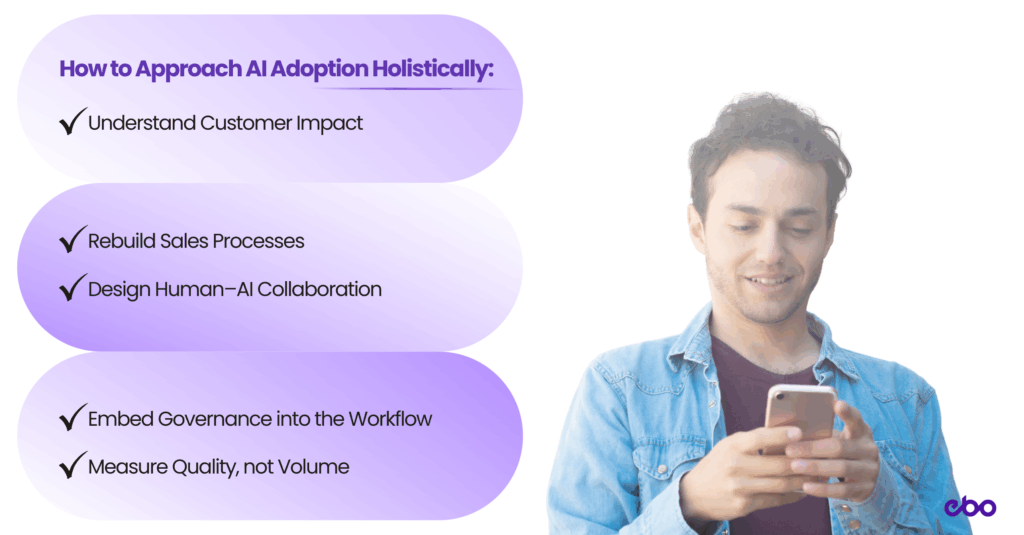
In practice, successful AI adoption sits across three things: tools, processes, and people.
And in most cases, when AI adoption struggles, it is because there are gaps in how these three layers connect, particularly in environments like financial services, where performance depends on precision, trust, regulation, and consistent human judgment.
Below, we look more closely at the human layer of AI adoption, and the decisions being made about where AI adds real value.
Trust Over Scale
When organisations start using AI in prospecting and customer engagement, the focus is usually on scale; more messages, faster outreach, higher output.
As AI-generated communication becomes the norm, prospects are no longer impressed by volume. They are filtering for relevance. And in a crowded digital environment, trust becomes the real differentiator.
Human + AI Operating Model
As AI takes over repetitive tasks like research, data enrichment, and first-contact outreach, the structure of sales and admin teams naturally changes.
Humans are moving away from volume-based work and focusing more on high-value stages like qualification, relationship-building, and closing complex deals.
This is a real opportunity but only if organisations design for it. Without clear intent, teams can become more efficient, but less focused on the work that actually drives revenue.
At EBO, human-in-the-loop design is a core principle, ensuring that AI supports teams with clear boundaries, rather than operating in isolation.

Human-in-the-Loop Control

High-Quality Training Data

Design-Led Safety & Control

Governed AI Adoption
Governance as Operational Design
Governance is often viewed as a compliance requirement, but in the context of AI, it is fundamentally an operational design tool.
In financial services, where every customer interaction can carry regulatory and reputational implications, governance is what determines whether AI scales responsibly or creates uncontrolled complexity. It sets the structure for how decisions flow through systems, how risk is managed in real time, and where human judgment remains essential to outcomes.
Strong governance ensures AI is not operating in isolation, but within clearly defined guardrails that protect both performance and accountability.
Redefining What “Good” Looks Like in Prospecting
AI fundamentally changes the definition of performance. When outreach becomes effectively scalable at near-zero marginal cost, success is no longer measured by activity levels alone. Instead, organisations should shift toward evaluating relevance, conversion quality, and engagement depth.
At EBO, this means moving beyond traditional output metrics and focusing on whether AI-enabled prospecting is creating more meaningful commercial conversations. In this new paradigm, “good” is not about doing more, it is about doing what matters, more intelligently and more consistently.
3 Hidden People Risks in AI Adoption
As AI takes on more of the prospecting workflow, teams become more efficient and processes move faster.
At the same time, the way people engage with their work begins to change. The early stages of prospecting, which traditionally build understanding of customer needs, messaging, and timing, become less hands-on.
On the long run, this can shape how teams develop their commercial thinking, how confident they are in making decisions, and how deeply they understand the reasoning behind the actions being taken.
Attention naturally shifts toward indicators that reflect real impact:
- Relevance of engagement: Whether communication is aligned to the customer’s context.
- Quality of interaction: Whether it creates clarity, interest, or trust.
- Progression to meaningful conversations: Whether it leads to outcomes that can develop further.
Let EBO help your organisation move beyond automation and start getting real value from AI.
At EBO, our AI-powered solutions across regulated sectors show that the future of financial services will not be built on more tools, but on smarter orchestration and human-centred design.
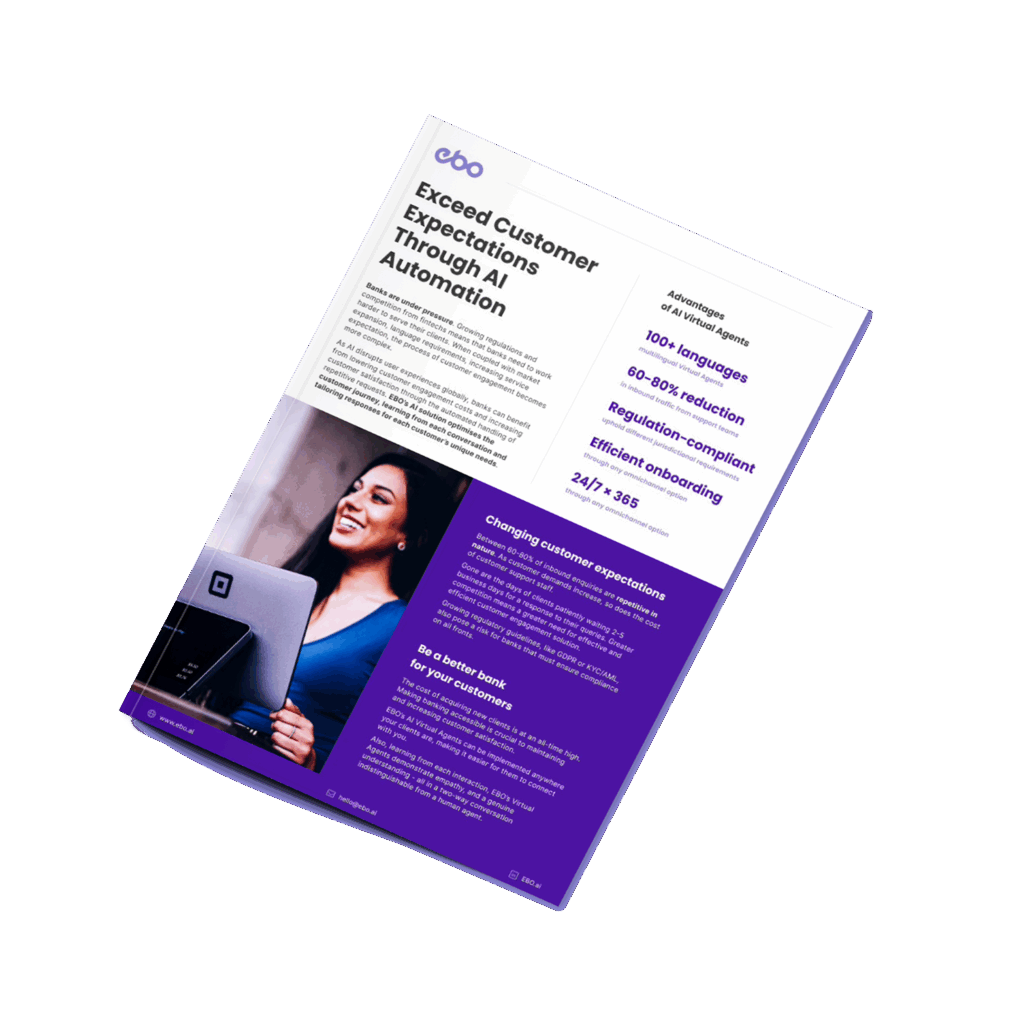
Access our guide to explore how financial services organisations are using AI to improve customer engagement, optimise operations, and keep people at the centre of performance.
Download Your Guide to AI
Access our guides to explore how EBO’s AI elevates every stage of the customer journey, depending on your industry.