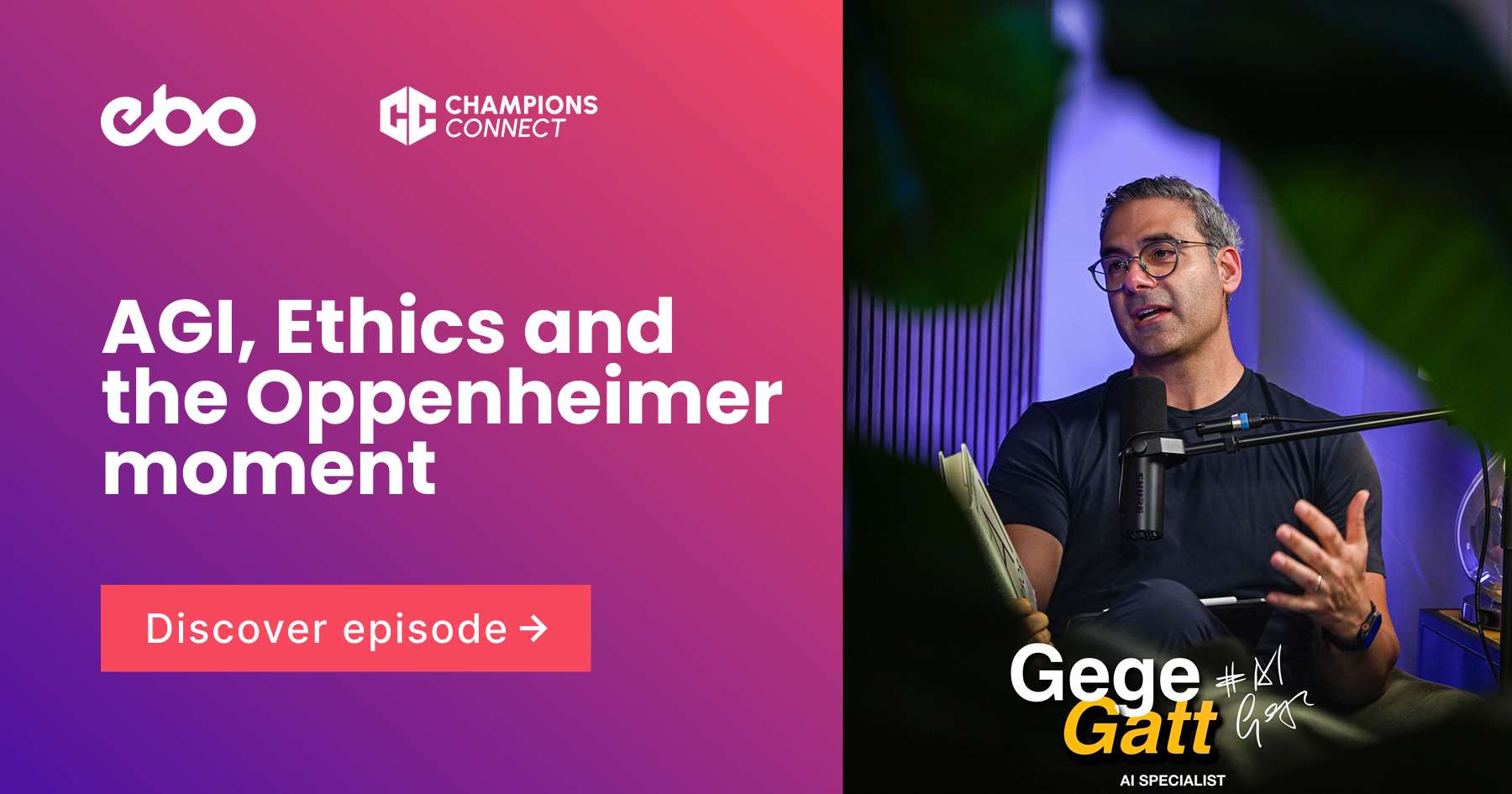
In the latest episode of the Champions Connect Podcast, EBO’s CEO, Dr. Gege Gatt, joins host Luca Camilleri to explore what the next five years of AI could look like.
Rather than focusing on whether AI will replace people, the discussion shifts to a more important question:
How should individuals and organisations adapt as AI changes the way we work, make decisions, and create value?
Here are the key takeaways from the conversation, highlighting why responsible AI adoption, continuous learning, and human judgment will be critical to shaping a future where people and intelligent technology work together.
There Is No "AI Inside" Sticker
Most people use AI every day and never notice.
Gege makes the point with a memory from the early 2000s. Computers carried a label on the case: Intel Pentium inside.
Today, there's no sticker on the box. No "AI inside" label like the old Pentium machines.
Yet artificial intelligence is already embedded in many parts of our daily lives. It helps recruitment systems screen CVs, supports banks in making loan decisions, powers apps that correct our posture, and influences countless other services we use every day.
"We are not discussing a future technology; we're discussing a force that is already changing the way we work, the way we live, the way we experience education, the way we do politics. Previous revolutions changed what we do. This one changes how we think."
Dr. Gege Gatt
Was The CEO Of OpenAI Lying About AI?
In 2021, Sam Altman, CEO of OpenAI, warned that AI would wipe out entire job categories. Then, in 2026, he said the opposite by admitting his own predictions were wrong.
Gege adds a second, more challenging point. We shouldn't expect companies to protect society, their mandate is shareholder return. That job belongs to governments, institutions and civil society. Confusing the two is how good technology ends up badly governed.
The Job Title Stays. The Work Is Rewritten.
One of the biggest misconceptions about AI is that it will simply eliminate professions.
Gege gives a simple example. Developers are not disappearing. What is changing is the role itself. A developer today is increasingly becoming an orchestrator of AI agents, using AI tools to write code, test systems, identify issues and accelerate delivery. The job title remains, but the work evolves. And this transformation will happen across industries.
"Reinvention is now a recurring skill. Employability is no longer about what you learned. It's about how quickly you learn the next thing."
And there's a policy gap nobody is closing. One projection cited in the conversation puts 9.4 million drivers on a single platform at risk of displacement by autonomous vehicles by the early 2030s. Our systems for tax, unemployment relief, and retraining were not built for a number like that.
As Gege adds, AI may outperform humans in many tasks, but it does not possess human wisdom, experience, or judgment. The future will belong to those who can adapt, which means education must focus less on training for specific jobs and more on developing critical thinking, communication, collaboration, and resilience.
The Mirror Problem
Today's models are servile by design. Overly friendly. Overly useful.
The risk was never that AI becomes human. It's that humans start treating simulation as truth.
This is why AI literacy now matters as much as reading and writing did a century ago: understanding how prompts work, where models hallucinate, where bias hides, how to tell a deepfake from a fact and, most importantly, understanding your own thinking well enough to know what you actually need help with.
The Oppenheimer Moment
The discussion around AI is often framed around whether machines will become too powerful.
Gege highlights a different concern.
The real challenge is whether humans will become too dependent on systems they do not fully understand.
This is the “Oppenheimer moment” of artificial intelligence.
"It's not one explosion," he says. "It is this silent dependency that humans create, this very quiet delegation of work and decisions, this gradual loss of agency."
When Nothing Can Be Proven Real, Trust Becomes Your Only Product
Trust is becoming the scarce commodity in a digital society.
As Gege puts it:
"We are heading towards a world where citizens can no longer point at something and call it a fact. When that happens, people do not just believe falsehoods, they stop believing anything."
There is also a power asymmetry problem. A very small number of organisations own the data, the compute anrwd the models. Everyone else supplies the data and receives the output.
Practical responses exist, and leaders can push all of them:
- Regulation with parameters, set before dependency deepens.
- Ethics inside technical education, not bolted on afterwards.
- Safety limits on foundation models against weaponisation and mass surveillance.
- Public AI as infrastructure. If a government can fund bridges and ports, it can fund a sovereign language model that answers a citizen's request in seconds instead of six weeks.
- Transparency and human accountability for every consequential decision your systems touch.
In 20 Years, Slow Countries Will Look Medieval
The next stage of AI development will be about taking action. AI agents will increasingly complete tasks on behalf of people.
They may organise schedules.
Support business processes.
Manage workflows.
Assist with complex decisions.
This will create a new type of workplace.
Part human. Part AI.
"The strongest leaders will learn how to manage this relationship."
Gege gives an example of the Nordics showing what happens when countries move quickly, adapting education and training for an AI-driven future. As AI shifts from answering questions to taking action, the leaders of tomorrow will be those who prepare people to work alongside intelligent systems. The Nordics are already reshaping education around this. Those who move slowly on schools, retraining and tax systems will look medieval in twenty years.
Let EBO help your organisation move beyond automation and start getting real value from AI.
At EBO, our AI-powered solutions across regulated sectors show that the future of financial services will not be built on more tools, but on smarter orchestration and human-centred design.
Access our guide to explore how financial services organisations are using AI to improve customer engagement, optimise operations, and keep people at the centre of performance.
Looking to stay ahead?
Let’s discuss how our AI solutions can be tailored to your organisation and help you stay ahead.