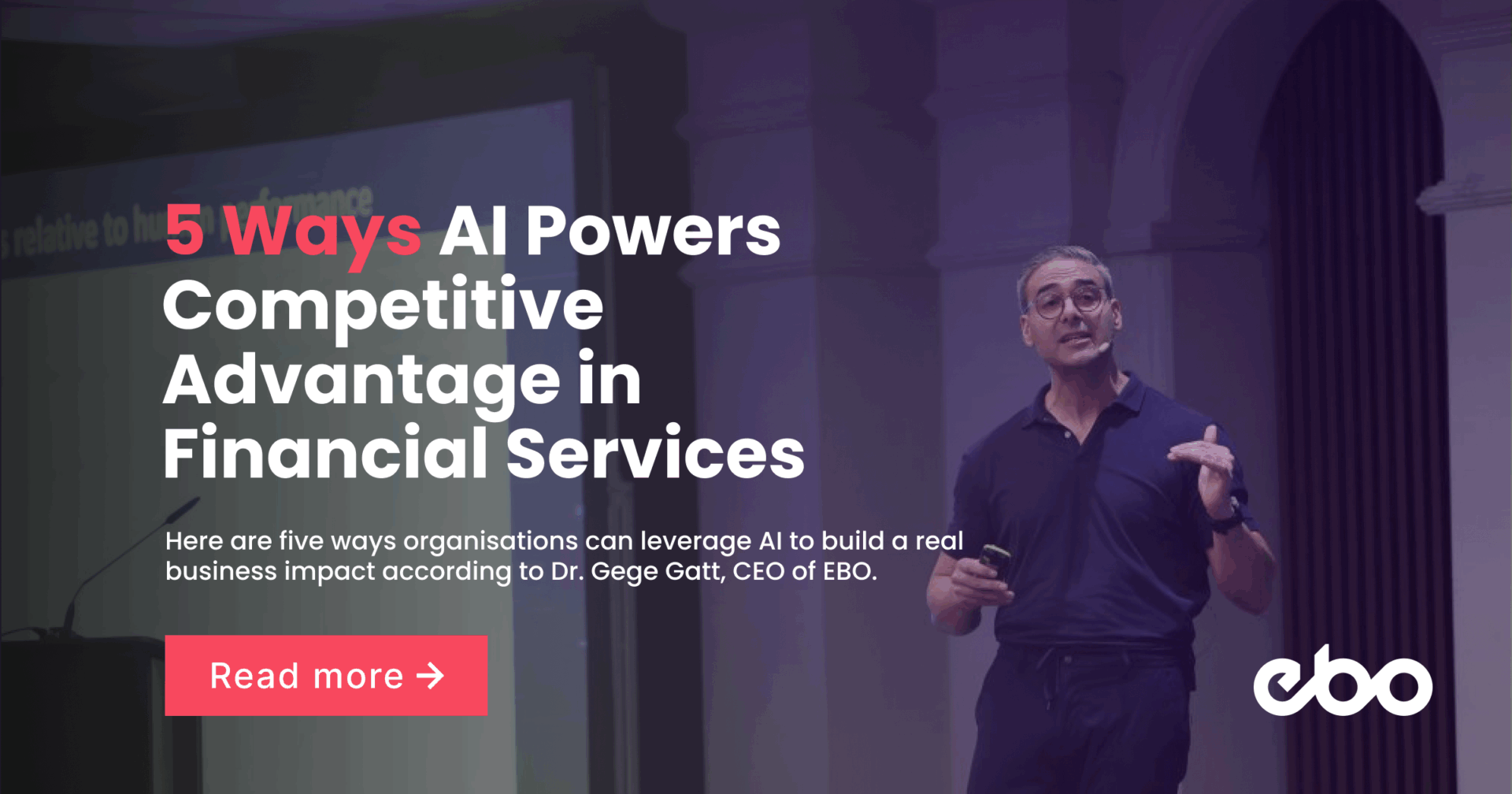
Based on his keynote at the NextGen Payments & RegTech Forum, organised by QUBE events, here are the key insights Dr. Gege Gatt shared on how AI is moving beyond compliance to drive real competitive advantage.
In highly regulated industries like finance, payments, and compliance, AI is often framed as a risk management tool. Something to help process KYC checks faster, improve transaction monitoring, or automate compliance reporting.
But that’s only scratching the surface.
AI is starting to change how organisations compete, especially in regulated industries where trust, speed, and accuracy matter most.
In his recent keynote on "Beyond Compliance. How AI Is Reshaping Competitive Advantage" at the NextGen Payments & RegTech Forum organised by QUBE events, Dr. Gege Gatt, CEO of EBO, highlighted that regulation is becoming one of the strongest drivers of meaningful AI adoption.
What’s needed now is smarter, context-aware AI that can adapt, learn, and support real-time decision-making.
So the question for leaders becomes: how can AI move beyond compliance and become a real competitive advantage?
Here are five ways organisations can leverage AI to build a real business impact.
1) Redefine What Your Organisation Is
One of the biggest risks for organisations today is defining themselves too narrowly. Many businesses still see themselves through the lens of what they have always done: banks see themselves as banks, payment providers as processors, compliance teams as rule enforcers.
But technology rarely disrupts tasks; it disrupts value creation. The companies that succeed in the AI era will be those willing to redefine their role before the market forces them to.
AI gives organisations the opportunity to evolve from service providers into intelligence-driven platforms that create entirely new value for customers.
2) Focus on Outcomes, Not Just Automation
Most organisations start their AI journey by automating small tasks: drafting emails, analysing documents, or speeding up internal workflows. While useful, these improvements rarely transform a business.
The real opportunity comes when AI is used to deliver outcomes rather than tasks. Instead of asking where AI can save time, leaders should look at where AI can take ownership of repetitive, high-impact business loops.
For example, in financial services, AI can move beyond simply flagging suspicious transactions to actively guiding customers, preventing fraud, and educating users in real time.
“For regulated financial services, this is a structural shift. AI is becoming an intelligence layer across prospecting, fraud prevention, compliance and customer protection.”
3) Shift From Apps to Intelligent Virtual Agents
The way we interact with technology is also changing. For years, digital services have been built around apps and interfaces where users manually perform tasks. AI is beginning to shift this model toward intelligent agents that can understand context and execute actions on behalf of users.
These systems don’t just respond to commands, they anticipate needs, monitor signals, and continuously learn from behaviour.
In the future, customers will increasingly interact with intelligent systems that act as companions, helping them make better decisions. Organisations that begin designing services around these agent-driven experiences will unlock faster, more intelligent customer journeys.
4) Experiment Early & Often
Many leaders wait for the perfect AI solution before acting, but in reality, that perfect solution rarely exists. The most successful organisations treat AI as a continuous learning journey.
They start with small experiments, test ideas in controlled environments, and gradually scale what works.
Over time, they build internal knowledge, confidence, and capability. In a rapidly evolving technology landscape, the organisations that learn fastest are often the ones that win.
5) Adopt an AI-First Strategy
Treating AI as an add-on tool limits its potential. The real transformation happens when organisations start thinking AI-first.
This means designing processes, decision-making frameworks, and customer experiences with AI embedded from the start.
Instead of simply making existing processes faster, AI becomes a core part of how the organisation operates and competes.
That’s why we’ve launched EBO’s AI Advisory service, a structured offering designed to help organisations adopt Artificial Intelligence in a strategic, secure, and value-driven way.
The result? A clear, execution-ready roadmap for scalable, governed AI adoption, completed in less than 3 months. Download our brochure to find out more.
Download the AI Advisory Brochure
Leverage EBO’s expert guidance and turn your AI ambition into strategic action.