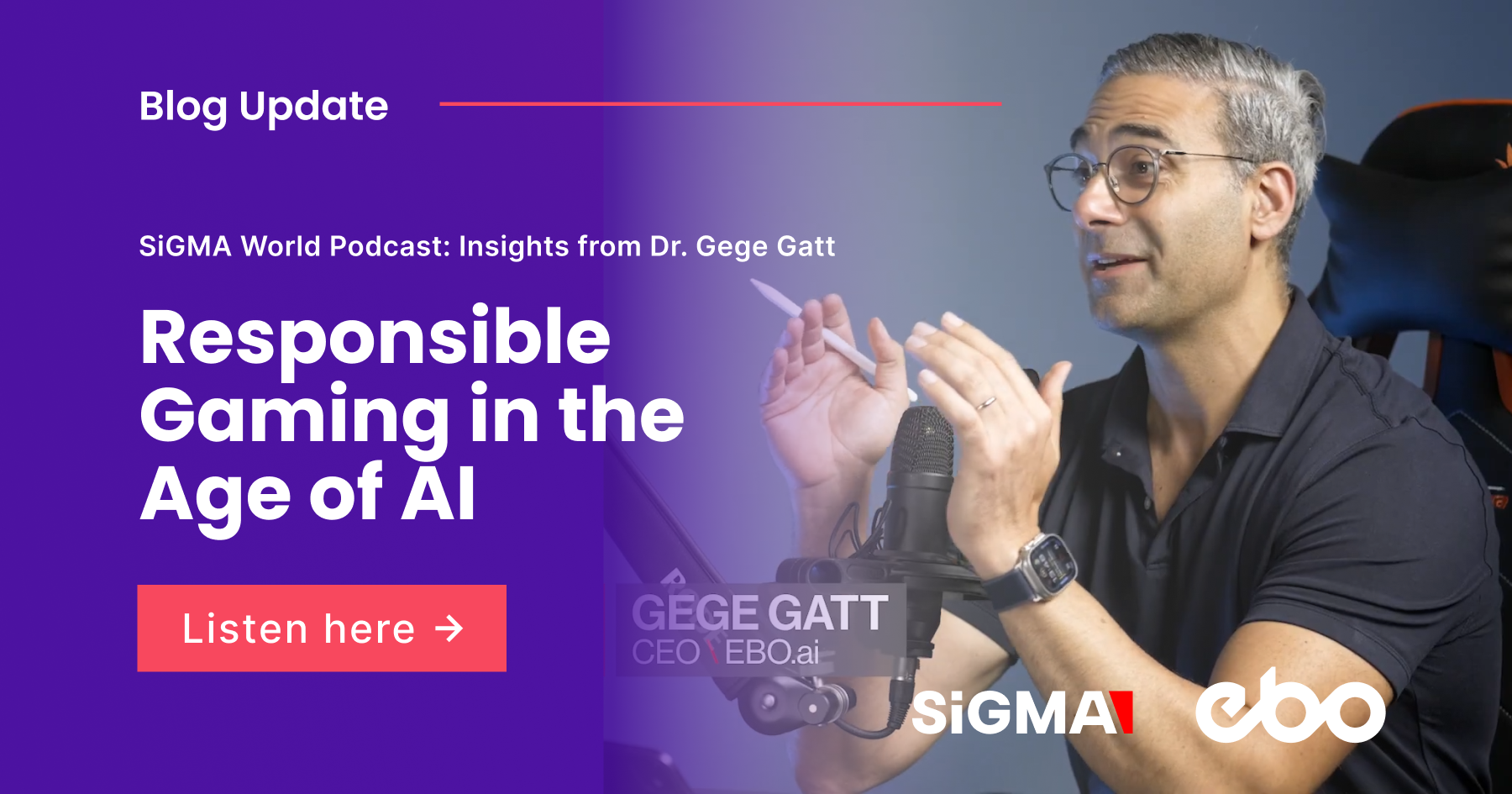
In the last episode of the SiGMA Podcast, EBO's CEO, Dr. Gege Gatt joins host Trevor De Giorgio, to unpack how AI-driven behavioural analytics and real-time data are redefining player protection.
The discussion challenges outdated, rule-based RG models and explains how machine learning can identify risk earlier, personalise interventions and strengthen trust while keeping human judgment firmly in control.
Here’s a closer look at the key highlights that stood out during the conversation. Together, they capture how AI is being used in practice today, the challenges operators face, and why combining technology with human judgment is essential for responsible gaming.
AI, But Make It Human
Artificial intelligence is often framed as the future of responsible gaming.
According to Dr. Gatt, it’s already the present. AI isn’t a shiny add-on or regulatory box-tick. Used properly, it’s becoming the backbone of how operators understand players, spot risk early and deliver care that actually feels personal.
“Artificial intelligence is great at detecting patterns… it can find the proverbial needle in a haystack.”
What follows is a model where technology sharpens judgement, improves timing and ultimately makes responsible gaming more human.
One Player, One Baseline
A major weakness of legacy RG systems is that they treat all players the same. AI doesn’t.
Instead, it builds an individual behavioural baseline for every player how they usually play, when they log in, how they stake and how long they stay.
“Every person has a different way of interacting with a game.”
Once that baseline is established, AI monitors deviations in real time, not weeks later in a compliance report. A normally casual player suddenly chasing losses at 2am? That matters and it can be acted on mid-session, not retrospectively.
This is where AI moves RG from reactive to preventative.
Understanding players in context
Context has always been one of responsible gaming’s toughest problems. Behaviour that triggers concern in one market may be entirely routine in another. During the discussion, De Giorgio pointed to Spain as a clear example where late-night gambling often mirrors social rhythms and daily schedules and not signs of harm.
According to Gatt, artificial intelligence is uniquely capable of navigating this complexity by layering multiple perspectives at once.
“Artificial intelligence can combine multiple data sources, culture, ethical frameworks, behaviours.”
By bringing together transactional activity, behavioural cues, third-party intelligence such as KYC data, and jurisdiction-specific insights, AI builds a far more nuanced view of player risk. The result is not a static label, but a dynamic risk profile one that evolves as the player does.
“Imagine an integer from zero to one hundred, which changes over time.”
As emotional states and behavioural patterns shift, so too does the risk score. This allows operators to focus attention where it truly matters, intervening with precision rather than blanket restriction.
A New Responsible Gaming Lens
For years, responsible gaming relied on blunt instruments: spend thresholds, deposit limits, and rigid “if this, then that” rules.
AI flips that logic entirely.
Rather than obsessing over the transaction itself, AI focuses on the behaviour that leads to it. Sudden spikes in bet size, changes in session length, erratic play or persistent late-night gambling all tell a story long before financial harm appears.
“Erratic behaviour is the most common precursor of risky behaviour… AI can identify the seed before it grows into a risky plant.”
This shift is critical. Harm rarely starts with one big bet. It starts with small, subtle changes, exactly the kind humans struggle to spot at scale, and exactly where AI excels.
AI as Infrastructure, Not an Add-On
Gatt was unequivocal on one point: AI cannot be treated as an optional extra.
Rather than being bolted on late in the development cycle, AI needs to sit at the heart of modern gaming operations underpinning monitoring systems, risk scoring, intervention workflows and customer support.
This shift has been driven by 4 key breakthroughs:
1) Increased computational power enabling real-time analysis
2) Unsupervised learning capable of detecting entirely new behavioural anomalies
3) Advances in natural language processing
4) The rise of generative AI, which allows for genuinely personalised communication.
“Imagine a cooling-off message… bespoke to you. That is effectiveness.”
Ethics and Empathy
For all its capabilities, AI is not a substitute for human responsibility.
Gatt closed the conversation with a clear caution against automation without oversight.
“AI should always be an augmentation mechanism and not a replacement mechanism.”
Technology can detect change, flag risk and surface patterns. What it cannot fully grasp is context, the life events, emotional pressures or personal circumstances that may sit behind a shift in behaviour.
That is why transparency, ethical design and human judgement remain non-negotiable. Efficiency may improve outcomes, but empathy defines them.
Curious to learn more about AI in iGaming?
Discover real client success stories and explore how our AI solution supports responsible iGaming in our complete guide.