How banks, fintechs, and insurers can scale customer engagement, embed compliance, and manage AI risk, and why 2026 is a breakout year for AI-powered financial services.
What began as isolated AI experiments and point-solutions with chatbots, fraud detection engines, robotic process automation, is now converging into a unified architecture built around six powerful, interlocking trends: Generative AI (GenAI), Digital Employees (AI agents embedded in day-to-day operations), AI-powered regulatory compliance (RegTech), Co-bots (Collaboration of Human and Robots) Responsible AI and Voice AI.
While much of the industry’s attention has focused on AI strategy and governance, the most significant transformation is happening in day-to-day operations. Across the EU and UK, generative AI and agentic systems are moving from experimentation into scaled, revenue-impacting deployment.
For institutions that want to stay ahead, competitive advantage lies not in deploying AI tools, but in architecting AI systems with embedded scalability, rigorous governance controls, and end-to-end auditability built in from day one.
1. GenAI Becomes the Brain of Customer & Operational Experiences
In 2026, Generative AI will evolve from content generation into structured, responsible decision support. Financial institutions are already applying GenAI to summarise cases, advise employees, classify customer intent, and respond to inbound communications with unprecedented accuracy.
But the real value emerges when GenAI is embedded inside workflows, not layered on top of them. For example:
⇒ Surfacing next-best actions for agents based on historical behaviour
⇒ Rewriting complex policy language in customer-friendly terms
⇒ Analysing large volumes of free-text data to identify emerging risks
The differentiator for top-tier financial services companies is integrated into the everyday mechanics of service, onboarding, fraud management, and communication journeys.
2. The Rise of the Digital Employee
The digital employee is no longer a conceptual term. It is becoming a fully operational workforce layer: AI-powered assistants designed to handle regulated customer conversations, standardise processes, and orchestrate multi-step tasks at a scale no human team can sustain.
Handle onboarding queries end-to-end
Gather missing documentation
Trigger back-office actions
Enrich customer data with every interaction
Escalate with context and reasoning

In 2026, digital employees will become a structural part of the workforce not to replace people, but to deliver consistent, scalable work that enhances human teams. They will operate across high-volume environments such as onboarding, payment queries, lending support, and claims handling, ensuring continuity of service - even in complex, regulated journeys.
3. Human–Robot Collaboration (CoBots) Becomes Mainstream
Collaborative robots, known as CoBots, have transformed manufacturing, and in 2026 their principles are increasingly influencing service industries, including financial services. CoBots are not traditional, fully autonomous robots. Instead, they’re designed to work with people, not replace them.
AI-powered CoBots combine human judgment with machine precision, taking over repetitive, rules-based work while elevating employees into higher-value roles. In physical industries, this looks like robots handling assembly while humans oversee design and maintenance. In financial services, the “CoBot” equivalent is emerging in digital workflows:
⇒ Automated agents assisting call-centre teams.
⇒ Interactive virtual assistants performing administrative tasks.
⇒ AI copilots supporting analysts, compliance officers, or relationship managers.
This shift creates hybrid workforces in which AI accelerates decision-making, reduces errors, and frees teams to focus on complex, creative, or customer-centric responsibilities.
4. AI-Driven Regulatory Compliance Becomes a Strategic Imperative
Regulatory frameworks across Europe and the UK are intensifying. With the introduction of the EU AI Act and increasing scrutiny from global regulators, institutions must demonstrate not only the outcomes of their AI systems but the logic behind them.
In practice, this means institutions need AI that can:

Produce audit-ready evidence across thousands of conversations

Ensure mandated disclosures are delivered

Monitor interactions in real time

Detect risks or non-compliant language as they occur.
5. Responsible AI
As AI systems increasingly shape decisions in finance, healthcare, and public services, institutions must ensure their models are fair, transparent, and aligned with human values. Responsible AI embeds accountability, bias mitigation, and explainability into every stage of the AI lifecycle, ensuring decisions can be audited and justified.
For financial institutions, this is now a strategic imperative. Regulators expect AI systems to be traceable, well-governed, and free from discriminatory outcomes. Customers expect clarity and fairness. Firms that operationalise Responsible AI through robust data governance, continuous model monitoring, and human-in-the-loop oversight will be the ones that scale AI confidently and earn long-term trust. In an era of rapid automation, Responsible AI is the new competitive advantage.
6. The Rise of Voice AI
Voice technology is one of the fastest-growing AI applications entering 2026. Natural language processing has improved dramatically, enabling voice systems to understand intent, authenticate users, and manage complex interactions.
Key applications emerging in Financial Services:

Voice-enabled customer support that deflects calls and resolves issues conversationally.

Voice biometrics for secure authentication and fraud prevention.

Speech-to-text analytics to transform call recordings into structured compliance data.

Voice-driven “AI advisors” offering hands-free portfolio insights or financial coaching.
2026: The Year AI Becomes Operational Infrastructure
By 2026, AI will not be an add-on to core systems, it will be the core.
At EBO, our AI-powered solutions across regulated sectors show that the future of financial services will not be built on more tools, but on smarter orchestration. AI that strengthens governance, supports employees, improves customer experience, and delivers compliant automation at enterprise level.
2026 will not be defined by the rise of AI but by the rise of responsible AI that fintech companies can trust.
Are you ready to take your AI journey to the next level?
Download our detailed guides below to get started.
Download Your Guide to AI
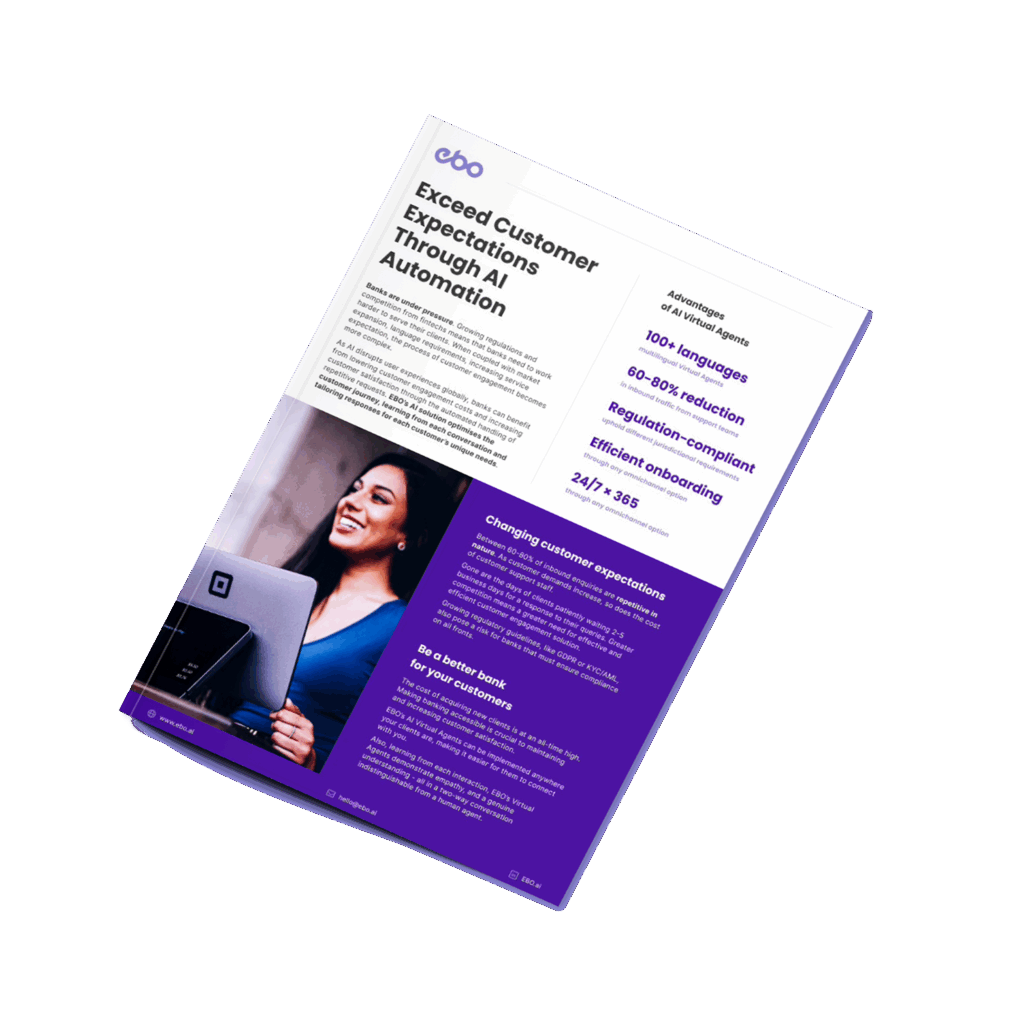
Access our guides to explore how EBO’s AI elevates every stage of the customer journey, depending on your industry.